
Floating leaves, colorful blooms, and an indoor water garden that’s a lot more doable than it sounds.
Say “water lily” to most people and they picture a pond. Koi fish, a few feet of open water, that whole scene. Fair enough, as assumptions go. But it skips over a whole group of compact varieties bred specifically for small containers — and these are perfectly happy on a bright windowsill or a sunroom table, indoors, no pond required.
Dwarf Water Lilies Indoors
It’s genuinely doable. Just less forgiving than, say, a pothos sitting on a shelf ignoring you for two weeks. Water lilies care about light, soil, container shape — skip one and it tends to show fast. Get those three sorted and the rest mostly follows on its own.
Can You Actually Grow Water Lilies Indoors?
Short version — yes. Not any water lily, though. And not without real light.
Dwarf and miniature varieties stay small enough for indoor containers and skip the water depth a standard pond lily would demand. They still want warmth, and a lot of light, to actually flower — so a dim apartment or a north-facing room is going to be a losing fight no matter what else you get right. But a south-facing spot with strong sun, or a grow light set up properly? That can turn into a genuinely striking centerpiece.
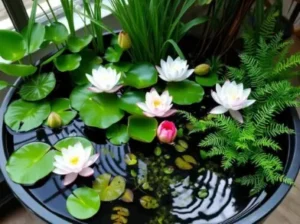
The mistake people make most often: underestimating how much light these things actually need. Fix that first. Most other problems either don’t show up at all or turn out easy to sort once the light’s handled.
Choosing the Right Variety
Matters more than almost anything else here. A standard pond water lily, crammed into an indoor bowl, is going to struggle. It wants more room, more depth, more root space than any indoor setup is realistically going to give it.
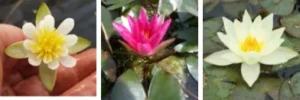
Dwarf and miniature varieties are a different story. Helvola is probably the safest place to start — yellow flowers, very compact, hard to mess up. Aurora shifts color as it matures, yellow drifting through orange into red. Pygmaea Rubra stays tiny, pink-red blooms, does especially well in small bowls. Pygmaea Alba is white and about as small as water lilies get. Indiana runs a warm copper-orange and tolerates slightly weaker light than the others on this list. Joey Tomocik is bright yellow and flowers freely without much fuss involved. Perry’s Baby Red stays compact with deep red blooms. Walter Pagels gives you white petals with yellow centers and performs reliably in containers, for what it’s worth.
Any of these stays manageable indoors and flowers well once conditions line up.
The Container — Wide Matters More Than Deep
Shape matters as much as size, maybe more. These plants spread sideways, not down — so a wide shallow bowl suits them far better than something narrow and deep.
Glazed ceramic bowls with no drainage holes work fine. So do sealed decorative planters, purpose-built tabletop pond containers, or a big glass vessel with enough room for roots to spread. Basically anything that holds water without leaking and gives the leaves enough surface area to spread out.
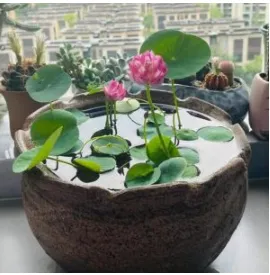
Rough target: width around 30 to 50 cm, so 12 to 20 inches. Depth somewhere in the 20 to 35 cm range, 8 to 14 inches. Lean wider rather than deeper. A lily stuffed into something too narrow runs out of room for its leaves before it’s even properly settled in.
Soil — Where Most Beginners Trip Up
Regular potting mix doesn’t work here. Too light, floats once it’s submerged, clouds the water almost the second you add it.
What actually works is heavy aquatic planting soil, sold specifically for pond plants, or plain garden loam with real clay content. Clay stays put underwater instead of turning everything murky.
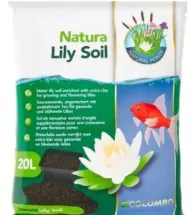
Skip perlite. Skip vermiculite. Skip bark chips, coconut coir, peat moss — all of it floats, all of it clouds the water, all of it creates an ongoing mess that’s a pain to undo once the container’s already filled and planted.
Once the rhizome’s in, layer washed pea gravel over the soil surface. Holds the soil down when you add water, and keeps any fish you add later from digging around in the roots.
Planting the Rhizome
The rhizome — that thick horizontal stem the roots and leaves grow out of — goes in at a slight angle. Not flat. Not standing up.
Set it toward the edge of the container, not dead center, angled so the growing tip points up and inward. Cover the roots with soil. Leave that tip exposed, though — burying it is probably the single most common mistake beginners make, and it’s likely the biggest reason a newly planted lily just never takes off.
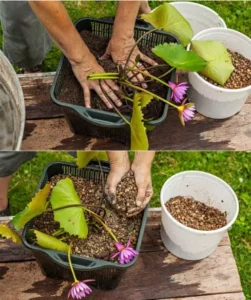
Once it’s positioned and the roots are covered, add the gravel, then fill slowly with water. Rush the fill and you’ll just stir up the soil, clouding everything before the plant’s had a chance to settle.
Light — Nothing Else Makes Up for This
There’s no substitute. These plants need a lot more light than your average houseplant, and if an indoor setup comes up short here, you get weak growth, no flowers, a slow decline — no matter how well you’ve handled everything else.
Aim for 6 to 8 hours of direct sun daily. South-facing windows give the best natural light indoors, in the northern hemisphere at least, and should be the first spot you look at.
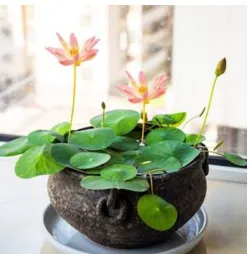
If natural light isn’t cutting it, a full-spectrum LED grow light right above the container makes a real difference. Run it 10 to 12 hours a day and you’ll often get better flowering than a south-facing window alone manages — especially in winter, when daylight hours shrink and even good windows start falling short.
Water Temperature
These grow actively and flower well between 22 and 28°C — 72 to 82°F. Outside that range, growth slows noticeably and flowering tends to just stop.
That rules out a few spots that might otherwise seem convenient. A cold window ledge in winter, where the glass temperature drops overnight. Anywhere near an air conditioning unit. A draughty hallway. Right above or beside a heating vent, where temperatures swing constantly through the day.
What these plants actually want is steady warmth. A warm, stable room with decent light beats a brighter spot where the temperature keeps jumping around.
Fertilizing
Water lilies eat more than most indoor plants do. Leave one unfed in a container and it’ll burn through whatever nutrients are in the soil pretty fast.
Aquatic fertilizer tablets, pushed into the soil near the roots every four to six weeks during the growing season, keep the plant fed without messing with water quality. They’re slow-release — nutrients go straight to the roots instead of dissolving out into the water.
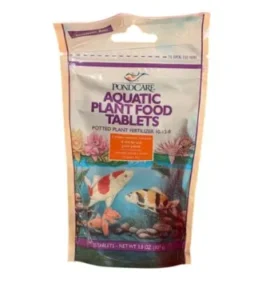
Regular houseplant liquid fertilizer isn’t a good stand-in here. It dissolves right into the water, feeds algae, and creates a mess that’s a lot more work to fix than just using the correct fertilizer type from day one.
Keeping the Water Clean
Indoor water gardens are easier than an outdoor pond, but not zero-maintenance. Ignore the water long enough and it goes cloudy, starts to smell, stresses the plant.
A few habits keep it in check. Pull yellow or dying leaves as soon as you spot them — don’t let them rot in the water. Trim spent flowers at the base once they’re done. Top up evaporated water with something dechlorinated — tap water left out overnight is fine, or use filtered. Wipe algae off the container walls with a cloth when it builds up. Keep general debris out of the water.
None of it takes long once it’s routine. Cleaner container, clearer water, healthier plant — in that order, roughly.
Common Problems and What’s Actually Causing Them
No flowers? Nine times out of ten, it’s the light. Fix that before touching anything else. Not enough fertilizer comes next. A container that’s too small can also stop the plant from establishing properly, which delays or blocks flowering altogether. And sometimes it’s just patience — a freshly planted rhizome can take weeks to settle before it bothers putting energy into blooms at all.
Yellow leaves? Check fertilizer first, then water quality. Older lower leaves yellow naturally on their own — just remove them, nothing to worry about there. A sudden temperature swing can also trigger yellowing that clears up once things settle back down.
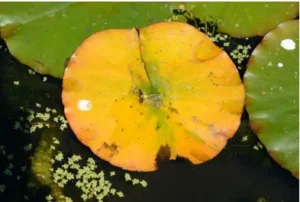
Algae piling up fast? Usually means light and nutrients are out of balance somewhere. Decomposing leaves feed algae, so pull them out as you notice them. Don’t over-fertilize. Keep organic debris out of the water and algae generally stays manageable without anything more drastic needed.
Adding Fish or Aquatic Animals
Small indoor water gardens can handle some aquatic life without becoming a whole project.
Snails genuinely help — they graze on algae, keep things tidier. Small shrimp do something similar. Tiny ornamental fish work too, in a big enough container, though they add to the bioload and mean watching water quality more closely.
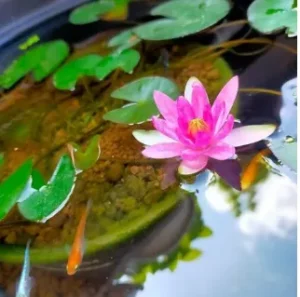
Very small bowls, anything under about 30 cm wide, are better left plant-only. Water chemistry in that little volume shifts fast once animal waste enters the picture, and keeping it stable ends up being more work than it’s worth at that size.
Best Spots in the Home
Placement really comes down to light more than anything. Beyond that — bright living rooms with south or west-facing windows, sunrooms, conservatories, a well-lit home office, an entryway that gets steady natural light, a kitchen with big windows.
Wherever it lands, try not to shift it around much. These don’t love being moved from spot to spot, and a container full of water is heavy enough that relocating it isn’t something you’ll want to do often anyway.
Quick Care Checklist
Dwarf or miniature variety, picked specifically for container growing. Wide, shallow container, no drainage holes. Heavy aquatic soil or clay-rich garden loam — no perlite, no bark. Rhizome planted at a slight angle, growing tip left exposed. Gravel layer over the soil. Six to eight hours of direct light daily, or a decent grow light running ten to twelve. Water held steady between 22 and 28°C. Aquatic fertilizer tablets every four to six weeks during active growth. Dead leaves and spent flowers removed as you notice them. Water topped up regularly with dechlorinated water.
Final Thoughts
Dwarf water lilies are one of the stranger, more satisfying plants you can grow indoors. Strange because barely anyone thinks to grow water plants inside at all. Satisfying because when conditions line up, the floating leaves and blooms genuinely stand out in a way most houseplants just don’t manage.
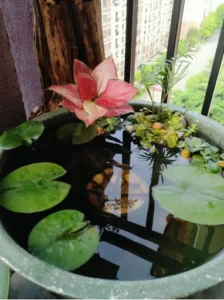
Light’s the real hurdle. Sort that — a good south-facing window, or a proper grow light — and the rest of the routine is straightforward enough that these end up far less demanding than they look at first glance.
Pick one of the reliable compact varieties, set it up right from the start, and there’s a decent chance it sticks around as a long-term fixture rather than a two-month experiment that fizzles out.