
Most people who want a home library spend years putting it off because they’re picturing something they can’t afford or don’t have space for. The dedicated room with rolling ladders and a fireplace. The two-story mahogany situation. The thing that requires an architect and a significant chunk of savings.
Dream Home Library Ideas
Here’s what’s actually true: the home libraries people use most aren’t always the grandest ones. They’re the ones where the chair is genuinely comfortable, the light is adequate for reading, the books are within arm’s reach, and the room — or corner, or nook — feels like somewhere you’d choose to be. That can happen in a single alcove just as well as it can happen in a dedicated room. It’s worth starting there.
1. Floor-to-Ceiling Shelves
Covering an entire wall from baseboard to crown molding does something to a room that partial shelving never manages. The vertical scale makes the space feel both grander and more purposeful — more like a room designed around a specific idea than one that just happened to accumulate furniture.
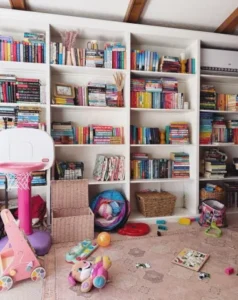
Built-ins have a finished quality that freestanding shelves approximate but don’t fully replicate. The wall-mounted system with the right bracket and shelf combination is a reasonable middle ground if custom built-ins aren’t in the budget — close enough to pass for custom at a fraction of the investment.
2. Rolling Library Ladder
A rolling ladder is one of those elements that’s both theatrical and genuinely functional, which is a rare combination in interior design. For tall shelving especially it shifts from decorative to necessary — upper shelves are only useful if they can actually be reached without hauling a separate stepladder in from a closet.
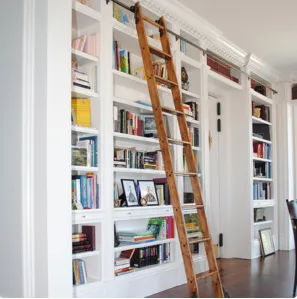
Even in a room with more modest ceiling height, a library ladder adds a seriousness to the space. The hardware matters as much as the ladder itself — good quality track in brass or matte black makes the whole thing feel architectural.
3. Window Seat Nook
The window seat built into a shelving nook is probably the most satisfying small-space solution on this list. The seat itself becomes the room’s best reading spot by default — natural light coming in directly, enclosed on two or three sides by shelving, cushioned and comfortable. It does everything a dedicated library does in a space that might be four feet wide.
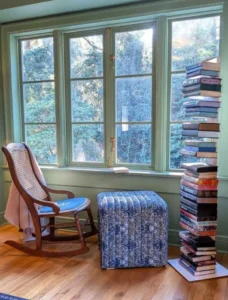
Storage underneath the bench is worth designing in from the start. Hinged tops or drawers add meaningful capacity to a small room without changing anything about the nook’s appearance.
4. Built-in Reading Bench
A bench built into the shelving rather than positioned in front of it creates an integrated feel that freestanding furniture doesn’t achieve. It belongs to the room rather than being placed in it. Sized specifically for the space, fitted with a proper cushion, flanked by shelves at arm’s reach — this is the kind of seating people actually use for long stretches rather than perching on for ten minutes before moving somewhere else.
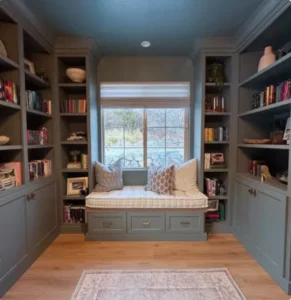
An integrated end table or built-in shelf at sitting height — for a lamp, a cup, whatever’s being read — completes it. Small detail, significant difference.
5. Moody Dark Walls
Not every home library needs to be bright and airy. Dark walls — deep navy, forest green, near-black, charcoal — create an enveloping quality that many readers find more conducive to actually settling in than neutral spaces do. Books tend to stand out more against a dark background too, which isn’t the primary reason to do it but is a secondary benefit worth knowing.
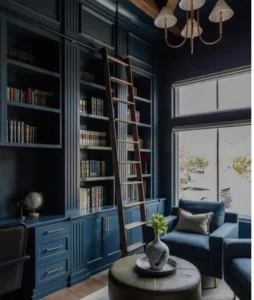
The combination of dark walls, warm lighting, a library ladder, and a leather chair is the most classically satisfying version of this. In smaller rooms especially, painting dark can make the space feel more intentional rather than just small.
6. Vintage Leather Armchair
The leather armchair is what a library calls for more than any other seating. The material ages in a way that fabric doesn’t — better with time rather than just more worn — the silhouette is established enough to work in almost any library aesthetic, and it reads as furniture chosen for serious sitting rather than occasional use.
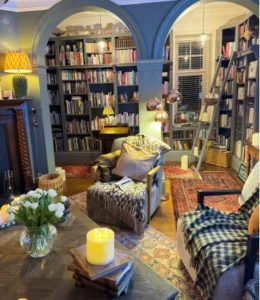
Chesterfield with rolled arms is the most traditional version. A deep wing chair is slightly more enclosed and private. A simple club chair that’s been broken in properly is the least formal and often the most comfortable. Paired with an ottoman and a lamp at the right height, any of these covers what a reading chair needs to do.
7. Warm Brass Lighting
A library with only overhead lighting is a library where nobody actually reads comfortably for long. The light source needs to be close to the page and positioned without casting shadows — table lamps at reading height do this in a way ceiling fixtures simply can’t replicate regardless of wattage.
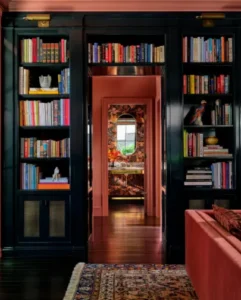
Brass sconces at wall-reading height, or a brass floor lamp positioned over the shoulder of a chair, add warmth that changes the atmosphere of the whole room. The color temperature matters more than people usually account for — warm white around 2700K produces the amber-tinged glow that makes a library feel like somewhere worth spending a long evening.
8. Arched Book Alcoves
Arched alcoves cut into a wall of shelving introduce a curved line into a room that’s otherwise all right angles — bookshelves, window frames, floor and ceiling meeting at ninety degrees everywhere. That interruption is visually welcome and adds an architectural detail that immediately lifts the room’s character.
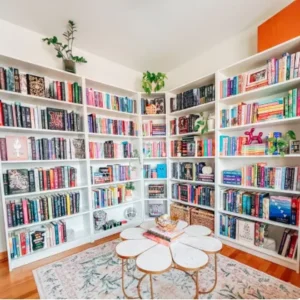
This works especially well in rooms with some existing architectural history. A chair centered in an arched alcove, or a piano occupying an arched nook adjacent to the library proper, gives the feature a purpose rather than leaving it as pure decoration.
9. Wool Rug
A library without a rug feels unfinished in a way that’s hard to articulate until one is added and the difference is immediately clear. The rug absorbs sound — which changes the acoustic quality of the room in a way that makes it feel more private and enclosed. It adds warmth underfoot. It defines the seating area within the larger space.
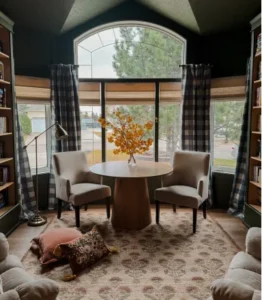
Wool specifically has a depth and texture that synthetic alternatives don’t convincingly replicate. A traditional pattern suits most library aesthetics without requiring anything else to make it work.
10. Dark Wood Paneling
Wood paneling on library walls creates warmth and structure that painted walls alone rarely achieve. The grain adds visual depth at close range while reading as a rich unified surface from across the room. It’s one of the material choices that looks better in person than in photos, which is relatively unusual.
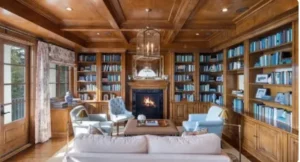
The combination of dark wood paneling, layered lighting — chandelier overhead, sconces on the walls, lamp at reading height — and a patterned rug is probably the most classically satisfying library interior achievable. It’s what people picture when they imagine a serious private library and, done well, it delivers exactly that.
11. Hidden Bookshelf Door
A wall of shelving that opens as a door is more achievable than most people assume and more satisfying than almost any other library feature. The bookshelf pivots to reveal a passage — to a home office, a small study, a reading room carved out of a larger space.
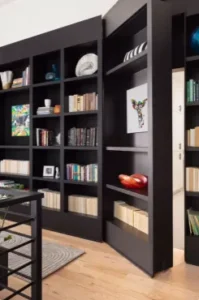
The hardware does the mechanical work of pivoting something heavy cleanly and quietly. The detailing — making the shelving on the door match the surrounding shelving closely enough that the seam disappears — is what separates a convincing version from one that looks like a movie prop.
12. Floating Shelves
Not every home library needs dramatic built-ins. A wall lined with floating shelves — clean, simple, books arranged with some breathing room between them — can feel as deliberate as custom shelving in the right room.
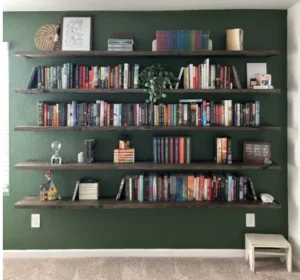
The constraint of floating shelves — shallower depth, less total capacity — encourages editing a collection down to what’s genuinely loved rather than storing everything ever purchased. That editing often produces a more considered result than unlimited storage capacity does.
13. Round Reading Table
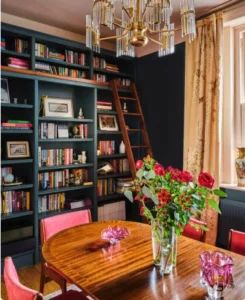
A round table in the center of a library suggests the room is for reading together rather than solitary occupation — book club meetings, shared research, family reading time. The form allows conversation around it in a way that rectangular tables with heads at opposite ends don’t. A large round rug beneath it defines the seating area within the larger room and gives the arrangement a centerpiece quality.
14. Classic Desk Corner
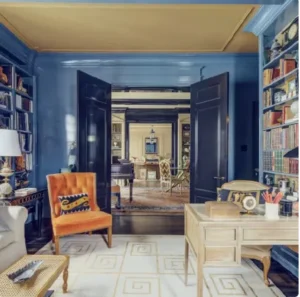
A desk in the library — positioned in a corner to keep the center open for seating, or built into the shelving as an integrated element — allows the room to function as a study as well as a reading space. The combination of comfortable reading seating and a proper writing surface covers most of what people actually want from a home library without requiring separate rooms for each.
15. Layered Lamps
Multiple light sources at different heights — a chandelier or ceiling fixture for ambient fill, wall sconces for mid-level warmth, table lamps for actual task lighting — produce the quality of light that makes a room genuinely pleasant to spend several hours in. A single source overhead, regardless of how bright, tends to flatten a room and make reading uncomfortable over time.
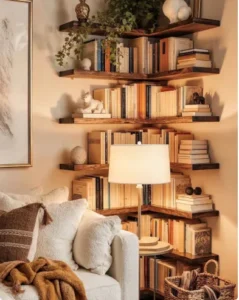
The table lamp positioned at the right shoulder to the reading chair — close to the page, not casting shadows — is the most important single piece of lighting in any library and often the most neglected.
16. Linen Curtains
Linen curtains in a library serve a purpose that goes beyond aesthetics — they protect books from UV exposure that fades spines and yellows paper over time. A south or west-facing room without window treatments can significantly accelerate a collection’s deterioration over years in ways that aren’t immediately noticeable but accumulate.
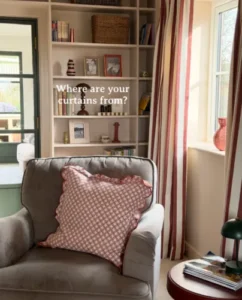
Neutral undyed linen suits most library aesthetics without competing with anything else. The slight texture catches light differently than smooth fabric, giving the curtains some visual interest while staying quiet enough to let the books and shelving do the main work.
17. Fireplace Reading Corner
A fireplace in a library is the combination that’s hard to improve on for a reading room. The warmth, the light, the ambient sound — all of it contributes to an atmosphere that makes a library feel like somewhere you’d genuinely choose to spend a cold afternoon rather than somewhere you go to retrieve a book and leave.
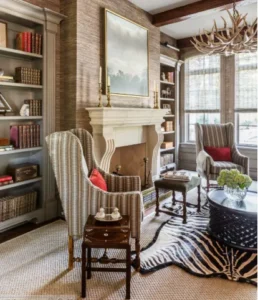
Floor-to-ceiling shelves flanking the fireplace frame it architecturally. One good chair pulled close, a lamp overhead, a side table at arm’s reach — the reading setup in a fireplace corner is the most elemental version of what a home library is supposed to be.
18. Books as Gallery Wall
Books arranged with some intention — horizontally and vertically mixed, some grouped by color, some by size, decorative objects and framed pieces integrated into the arrangement, breathing room between groupings — function as a gallery wall in their own right. The result rewards looking at closely while reading as a considered collection from across the room. It’s treating books as visual elements rather than just content to be stored, which changes how both the books and the room feel.
19. Velvet Chaise
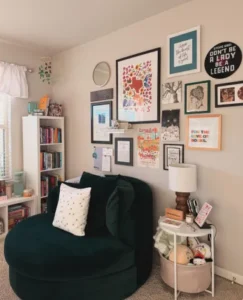
A chaise in a library is for people who read seriously enough that sitting upright eventually stops feeling comfortable. The fully reclined position — legs up, head propped, book held at reading height — is genuinely different from any chair configuration and suits long reading sessions in a way chairs rarely manage to match.
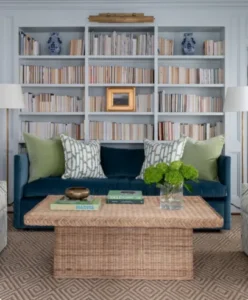
Velvet adds luxury to the piece in both appearance and feel. A rich jewel tone — deep green, burgundy, midnight blue — suits a library aesthetic considerably more than neutral upholstery typically does.
20. Antique Globe
An antique globe on a stand has been connected to serious private libraries long enough that the association feels natural rather than affected. It implies a particular kind of curiosity about the world that connects naturally to a room built around books.
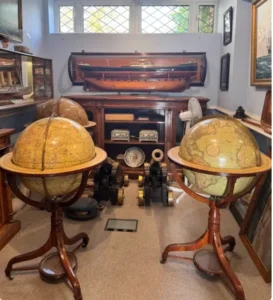
One with some actual age to it — worn, slightly faded, showing political boundaries that no longer exist — has more character than a reproduction. Worth looking for at antique markets and estate sales rather than buying new.
21. Under-Stair Library
The space beneath a staircase is consistently underused and naturally suited to a small library. The sloped ceiling and enclosed quality creates an intimacy that works genuinely well for reading, and the unusual shape becomes an asset rather than a constraint when the shelving is designed around it.
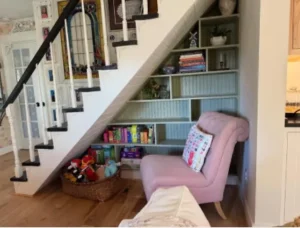
Built-in shelves following the slope of the stair, a small bench tucked into the deepest corner, a reading lamp on a wall bracket — this produces a nook with more character than most purpose-built rooms, in space that was otherwise doing nothing.
22. Corner Reading Nook
A corner nook — built-in bench with shelving on two walls meeting at the corner — uses space that most rooms either leave empty or fill with furniture that never quite fits. The L-shaped arrangement creates an enclosed feeling without requiring a dedicated room.
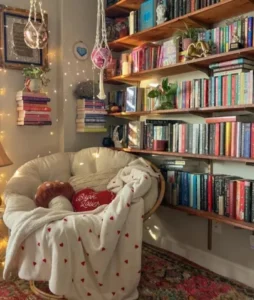
A window in the corner brings in natural light for daytime reading. Storage beneath the bench handles the practical overflow. Both together produce a reading space that earns more daily use than most formal library rooms do.
23. Library Ladder on Full Track
In a room with genuinely tall shelving — or even just ambitious floor-to-ceiling height — a ladder on a full-length track becomes necessary rather than decorative. Upper shelves are only useful if they’re actually accessible, and a separate stepladder dragged in from elsewhere defeats the purpose of having a proper library.
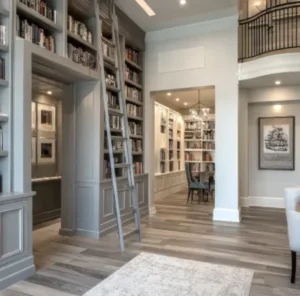
The track hardware — cast iron, aged brass, matte black — should match the other metal details in the room. Treating it as purely functional rather than as a design element worth finishing properly is the thing that separates libraries that look considered from ones that look assembled.
24. Glass Cabinet Shelves
Glass shelves within glass-fronted cabinets protect books from dust while keeping them visible — the collection is displayed rather than hidden, but the glass gives it a slightly more curated and formally presented quality than open shelving does.
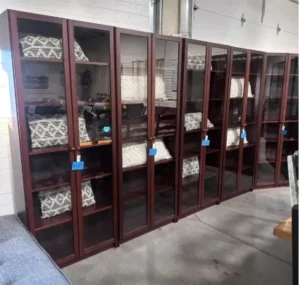
Lit from above or within, these turn a bookcase into something closer to a display cabinet — light passing through the shelves, illuminating books below, making the whole unit a focal point rather than just storage. This approach also protects books in rooms with significant natural light, where open shelving would leave them vulnerable to UV exposure over time.
The library that actually gets used consistently is the one where sitting down to read feels like an obvious thing to do rather than something that requires preparation. Good chair, good light, books within reach, a room that feels like it was meant for this. That can happen in a corner with a few shelves and a lamp just as genuinely as it can happen in a room designed from scratch — it’s the quality of the setup that matters, not the scale.